Archive for the 'Uncategorized' Category

Why didn’t they dissolve the Republican Party when they had a chance?

Friday, July 6th, 2007

From “The Republicans Face a Great Decision”; NY Times 6-20-1937; Delbert Clark.
These are the questions that are now agitating the more thoughtful members of the party, the politicians who, after three disasterous defeats at the polls in the space of five yeras, are now thinking less of the immediate fruits of officeholding and more of the broader aspects of political theory.  The party is, in short, in the position of a man with heart disease, whose problem has become not “Shall I play golf?” but rather “Shall I live to play golf again?”

[…] Between 1932 and 1936 the Republican leaders still had hopes and many of them, by November of last year, had by a species of self-hypnosis convinced themselves that the party would squeak through and beat Roosevelt.  The overwhelming New Deal victory dispelled all illusions and today the party’s leaders, in and out of Washington, are wondering aand discussing among themselves what the next step shall be.  Of one thing most of them are convinced: the party must find iron leadership and a valid set of principles if it is not to vanish as a name and as a political entity.

Yet so uncertain are they concerning particulars, so confused by the variety of immediate issues presented and teh conflicting types of leadershiup all climing to have communed with the burning bush, that none of any responsibility will publicly discuss their thoughts.  Vandenberg, Borah, Hamilton, Snell, Ogden, Mills, Wadsworth and such self-constituted leaders will talk volubly in private, but for public consumption will utter nothing but generalities — and very few of those.  They are too busy thinking.

From private discussions with some of these real or putative leaders one startling fact emerges.  There is a willingness, inconceivable four years ago, to consider the possibility of discarding the party, as Republican party, altogether and of issuing a new manifesto under a new name with the salutary purpose of eliminating fundamental antagonisms and starting afresh on a solid, if small, basis.

A number of factors have incduced this revolutionary thought.  It is not merely that the shell of the Republican party is filled with warring elements who agree on nothing but the party name and who cannot be counted upon at the polls.  That  would perhaps lend plausibility to the theory that the party is dead already and must inevitably disintegrate and disappear in fact as well as name.  But the factor that adds hope to teh future is the knowledge that the Democratic party, while in overwhelming majority at the moment, is in almost as serious a state of internal disintegration as the Republican.

With the indutbitable fact in mind, some of the more thoughtful Republicans believe that a new conservative party, sprung from the remnants of the Republican, would rally to its standard innumerable Democrats who would never vote for the Republican label but who are sufficiently disaffected from the New Deal leadership to join a new party that represented their true convictions.

These Republican leaders know that the Democratic party, so far as its national aspects are concerned, has become the Roosevelt party.  They know also, from public manifestations and private conversations, that large numbers of conservative Democrats, with sufficiently outstanding leadership, would welcome a way out of the dilemma.  They would prefer, for sentimental and traditional reasons, to remain Democrats and get rid of the New Deal, but to many of them that begins to look like the tail’s attempting to wag the dog.

To many political observers in Washington it is apparent that the object of President Roosevelt and his closest advisers, from the very day he formally accepted the nomination in 1932, has been to reconstruct the Democratic party alon gliberal, up-to-date lines.  He has appointed well-known Republicans to high office; he has publicly , and courted the support, of politicians who have been high in the Republican councils.  He has, it is true, given public aid and comfort to old-line Democratic leaders who violently distrust the New Deal, but he has sought steadily to vitiate their influence by adopting a legislative program generally anathema to them.  He has appeared to be seeking to build up  anew liberal nucleus within the Democratic party in the hope that eventually it will be strong enough not to need the unfailing support of the Solid South.  Eventually the Democratic party would become once more a truly national party, the logical split would occur and the Republicans could have the conservatives.  Up to now the old-line conservative Democrats have rallied around at telection time, and have not deserted the party label.  They cling, for sweet sentiment’s sake, to that label, but they may not cling for many more years, and it is upon their expected defection that the Republican planners are coutninng to fortify their new party, if and when it is announced.

[…] Some time between then [1938] and 1940, following this line of reasoning, they would work out a mutually satisfactory declaration of principles, laid down under a new party name, and go to the country in that year united and revitalized.  They are frank to admit that they might not be able to swing the [1940] election, short of a great popular revulsion against Roosevelt, but they would not be too dissatisfied if they could make as good a showing as the Republican founders did in their first Presidential campaign back in 1856.

If such a new party were to be proclaimed, however, its founders would have no authority to pronounce the last rites over the GOP, and they would find at the very outset determined opposition to such a cavalier jettisoning of the old name and tradition.  But the opposition would find itself divided into two bitterly antagonistic groups: […]  The very fact of their initial split, of course, would weaken the force of these groups, and it readily to be assumed, in the opinion of some who are thinking of a new party, that one of these dissident groups would presently lose itself in the Constitution Party, the Liberty Party, or whatever it chose to call itself.    But this very question of which way the new party would lean, other than in general opposition to the Roosevelt political dynasty, is one which is agitating its would-be-founders most.  Among them are men who are by the standards of the current decade ultra-conservative, and others who would go far down the line with much Roosevelt legislation, but who oppose with all their souls the political tactics of the New Deal and the administrative authoritarianism which they profess to see animating Mr Roosevelt.  Some of these men honestly believe that civil liberty in the United States is in grave peril; that we are headed in the direction of an American brand of fascism, and that it is their patriotic duty, regardless of prior party affiliations, to oppose that trend.
[…] There is still another ground however, more fatalistic, more studious of historical precedents, which predicts the early demise of the Republican party without a successor.  They reason it this way: [back to James Monroe and a one-party state, more or less, Republican Party anomolie.]

……………………………

I probably posted too much from this article.  Main focal points are the terms “Liberal” (and its cousin – slash – mask in terms of the current political dichotomy “progressive”), what to make of a “Conservative Project” at its lowest ebb, as well the slow political alignment that held the Solid South until the Republicans now have — not quite a “Solid South” but a dominance nonetheless that holds the South as a political bloc in presidential elections (and Congressional pluralities).
Next up (or probably not “next” but sooner or later), if I can find it, 1938 polling — the conservative – liberal labels (self described) are at parity.  Meaning what, precisely –?
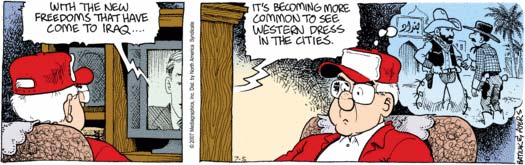
in the funnies…

Thursday, July 5th, 2007

Taken from “Josh Reads”, who adds the essential commentary:

Actually, from everything I’ve heard, the replacement of a brutal but essentially secular dictatorship with an elected coalition of religious-based political parties has resulted in Western dress becoming less common, not more, in Iraq.

But I scratch my head and wonder “What world is the cartoonist behind Crankshaft living in”?  I suppose somewhere on the same neighborhood as The Family Circus.

Somewhere in the mind of this cartoonist is a view of the world’s path to freedom along the lines of The Soviet Union’s collapse and market forces bringing Blue Jeans, Pepsi Cola, and The Beatles into a thirsting public tired of taking whatever the Central Government handed out.

Our popular imagination of freedom in Afghanistan sort of trickles back and forth between allowances of Afghan custom and visions of burka-less mini-skirt regalia.  (Note: I linked to the first site google shows when doing a quick search for how we’re assimilating our visions of Afghanistan.)  Iraq is not Afghanistan — only in the 1990s under sanctions did it devolve into a third world economy, but the essential point of equating whatever the heck we’re wearing as the end all and representation of “Freedom” ™ holds forth nonetheless.

Oh well.  It is not as though anybody reads this comic strip.  I mean, really.  Crankshaft?

Udall and the two Romneys

Wednesday, July 4th, 2007

Mo Udall and George Romney.

Two Mormons who pursued the Presidential nomination for the two major parties.

George Romney was the front-runner for the Republican nomination until he offered up a gaffe to the effect that he was brainwashed by the Viet-Cong, a statement that no matter what a voter thought about the Vietnam War unnerved everyone.

I saw something about Mo Udall from contemporaneous sources from 1976 arguring against the use of “liberal” to use in conjunction with his politics, instead urging the word “progressive”, which may or may not be a major point of departure for one of the most obnoxious words in America — and I have been meaning to look up and sort out the histories of those two words and how they came to have their precise usages today. As for Udall’s birth-faith, from wikipedia:

During the Michigan primary, the Carter campaign had Coleman Young, the mayor of Detroit, accuse Udall of racism for belonging to the Mormon church, which at the time, did not allow blacks to serve in the church’s priesthood (since changed in 1978 by revelation to the Mormon prophet, Spencer Kimball). Young’s attack was at least somewhat unfair, since Udall had been a longtime critic of that church policy, and had ceased being an active member because of it. Carter’s subsequent sweeping of the black vote in the Michigan primary was key to his crucial and narrow victory in Michigan.

Today, Mitt Romney is running for the presidency, and his Mormonism is believed to be a negative to the Christian Right in particular and the nation at large — and a prominent conservative has a book out entitled “A Mormon in the White House”, and Mitt Romney is walking a fine line in offering up that he does indeed worship Jesus. I do not know if all of this afflicted his father when he ran for president. I do know that George never strapped his dog on top of his car in a cross country vacation, or professed admiration for a book written by the founder of Scientology, so maybe these things have a way of working itself off without regard to these things.
I will say that while a Mormon may end up in the White House eventually, I do not believe that we will ever elect a polygamist to the White House.  A homosexual may end up in the White House down the road, but in terms its subcultures, I suspect that we won’t elect a drag queen — gay or straight, which I guess means that Giuliani is out.

Curiouser and Curiouser

Wednesday, July 4th, 2007

I: A comment that just came through to the matter of Star Trek’s Robert Beltran and his rather odd career choice:

I think Beltran almost walked when Lyn began to loudly promote the choral work while denouncing the work on drama. I think he was handled by the Boomers and his ego massaged after some of lyn’s more pointed comments got out. I especially remember a cadre school session where lyn made remarks about people in drama wanting to change sex partners and it was better to focus on the discipline of the choral work. If I can find a transcript of the session, I will include Lyn’s words.

Paging Motherskadi, maybe the one person most interested in the matter of Robert Beltran and his connections with Larouche.

II: Other items of note: the feed shows many splogs linking to one of those Larouchian articles entitled “Larouche Challenges Youth: Make a Revolution in Science”.

Which I take to mean to man the wikipedia sites and attempt changes to entries on various scientists to fit Larouche’s cargo cult, and not much else in the realm of “Revolution”.

Infinitesimal?

Actually, referring to anything as a “Cargo Cult” is a sleight to cargo cults, which after all make sense to someone not understanding the world around them with no way of figuring out what those world powers beyond their reach are doing.

III: Persistence did not pay off for some LaRouche followers who were yap-yapping about how LaRouche can save the universe from the Baby Boomers, and how only he can save us all from imminent economic disaster – oh – and yeah – he will impeach Cheney too by the way.

I stopped to point out the Cheney-doings of Patrick Fitzgerald the United States attorney in Chicago.

This lady answered, “Who’s Pat Fitzgerald?”
You will notice that the Larouche reason for Impeaching Cheney, and if you google “Impeach Cheney” Larouche has a site on page one of google searches, now fits around an obscure scandal in Great Britain — something that manages the feat of getting the British Royal Crown in, as well British mps who call for an investigation into the death of Jeremiah Duggan. (Jeremy Duggan?)
The question of who Patrick Fitzgerald is to a LYM reminds me of how the easiest way to detabilize a yute is to ask either questions about the lunacy of the cult or ask a serious question about an important issue’s technicalities. In so many races we used to run candidates in we had eveyone fired up about somtehing like the SDI or increasing exports. We looked like fools when someone would ask a question in a TV debate about something like “do they support a change in the PBA pension funding as per bill 1669”. Our people would quickly mouth off that “if we adopt Lyn’s IDB proposal we would be able to do what needs to be done”

If you asked about an SSI COLA figure you got “Laruche’s Export-Import Bank proposal vis a vis the world wide developmental forces who are fighting the British Dark Ages proposal of Prince Philip would resolve this issue”.

All I could do was cringe and plan my eventual escape as it became clear to me that this was all a parlor game of Lyn , designed not to work except to make worshippers. Lyn would issue memo after memo stating that there are NO LOCAL ISSUES except the election of him to save the USA and humanity as the world faces ” A Thermonuclear War and a depression”. This has been the case from the first time we ran candidates in the 1970s to now. You never see how crazy this is until you leave and then see it again.

IV. If Factnet implodes, the new forum is here.

V. Jeff Steinberg is always on the lookout for more ex-members to re-recruit to his post-LaRouche Steinbergian thinktank. He used the occasion of Ken Kronberg’s funeral to renew or try to renew a lot of acquaintances…. Rather ghoulish. Mostly he’s interested in former NEC and NC members (National Executive Committee and National Committee).

He claims he will “reform” the organization and it will be what it was supposed to be. Of course, it IS what it was supposed to be…. And Steinberg is one of its biggest enablers.

I visualize Krushev’s speech denouncing Stalin for some reason.

Two ill begotten traditions of July 4th

Tuesday, July 3rd, 2007

#1:  That stupid hot dog eating competition, sponsored by someone who I don’t care to remember that deals in hot dogs, shown on ESPN 2 or thereabouts.

#2:  The most jingoistic movie of the last decade and a half: Independence Day.  There is much to be said about this movie — how it was basically billed as a huge budget B-Movie and you have to suspend disbelief in the multitude plot holes and leaps of faith the audience is supposed to make, but what I will say is that it is a fun movie to watch with a foreigner, who won’t help but get a little mad at some of the relentless panderings to American.

I already celebrated Canada Day, so I think I’m fully covered for Independence Day.   When’s Bastille Day?

Ron Paul: You heard it here third

Tuesday, July 3rd, 2007

Viewing some uptiks in his poll number, as well collapses and general humming hooing toward the Republican standard-bearers generating no particular excitement, I see a chance, and I do not know how large it is and I do not know if I would really be willing to bet on it, that Ron Paul might win or do very well in the Iowa Caucuses and/or the New Hamshire Primary.

And that would be the end of it. Ron Paul would get no further than that, until I guess he signs up for the Libertarian Party nomination.
Ticking off the precedents of Primary upsets, which includes Estes Kefauver against Harry Truman in 1952 and Eugene McCarthy against Lyndon Johnson in 1968 — the former a victory, the latter one of those “exceeded expectations”.

The more meaningful precedents for my quasi-prediction with Ron Paul are 1988’s victory by Pat Robertson in the Washington state caucuses and the New Hampshire quasi-victory and 1996 actual victory of Pat Buchanan. These were victories by a dedicated core of supporters, not altogether aligned with the Republican Party but there nonetheless, with a crowded group of candidates of poblematic natures.

I can’t say which one is more likely. Given the nature of the state of New Hampshire and the nature of caucuses, I think that if New Hampshire held caucuses I may just suggest putting money down. As it were, only if the odds makers give weak enough odds, and only if you are playing a game of horseshoes.